
Issue 18
2025
Born Hungry
Sydnie A. Howard
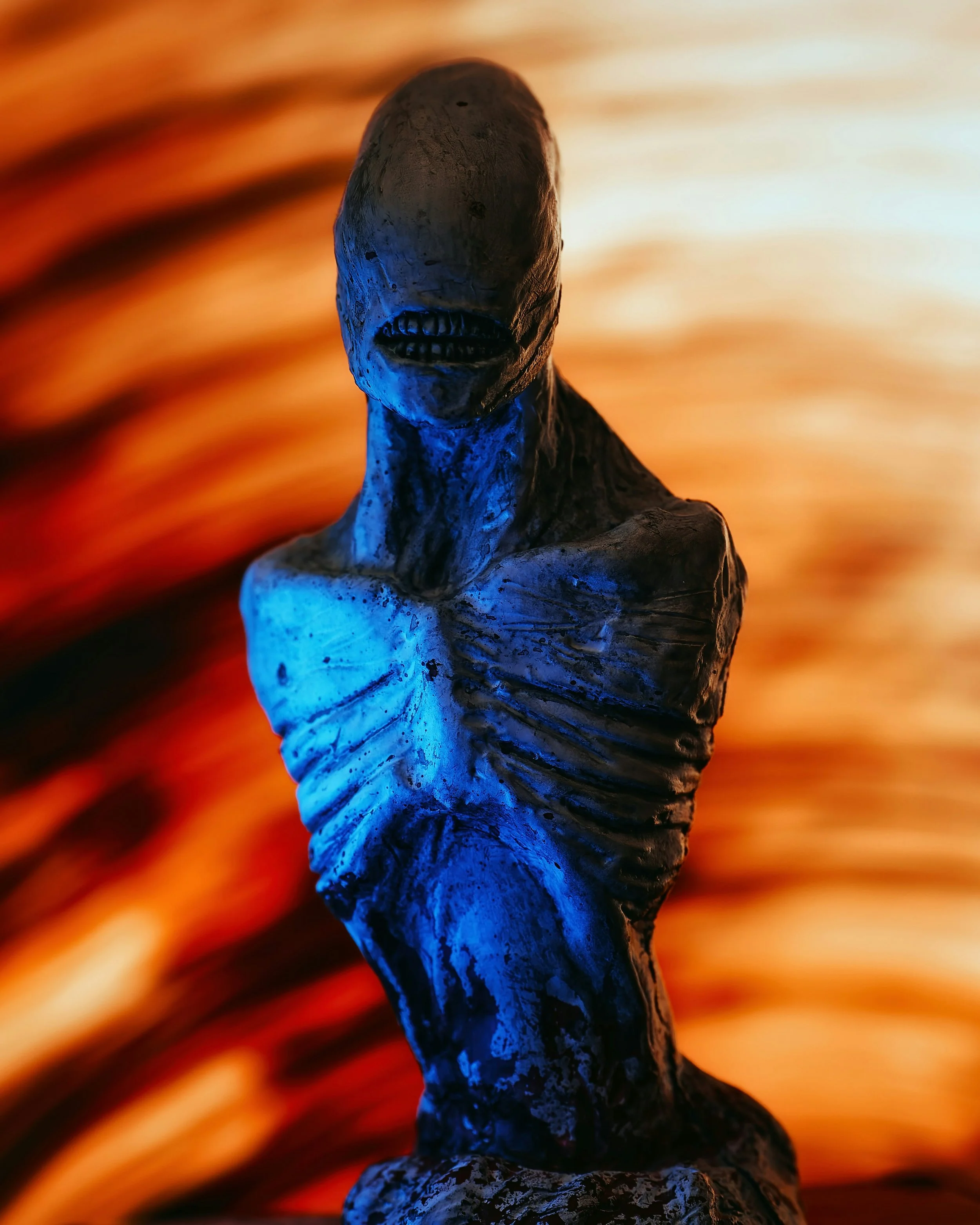
The alien is born hungry.
It has teeth the size of pins and eyes the color of a mother’s pale-pink lip liner. You can’t taste it, but it leaves your mouth tangy with the familiar palate of your gnawed gums. It smells like the omen of the burning bush: biblical yet revived, pushed with haste into a new world that turns on its side like a doll trapped in a music box.
You watch as the alien thrashes and contorts until its violence breaks the container it’s stuck inside. It births itself, and you can only watch with bloodied lips, flooded over with a carnal desire to detach from this world, from the alien, from yourself. But you know the alien can’t help it, for it is born hungry. So were you. So was everybody.
The alien is doomed to be hungry.
It just broke out of the abdomen of your best friend whom you’ve loved since fourth grade. You focus on the dragon tattoo on her sternum, how it’s peeled back by the alien bursting out like a car accident, like the repulsive voice of the man harassing you at the gas station—“Smile, dumb bitch”—who drunkenly stepped in front of moving traffic. You were grinning now, and you wished he could see.
The alien looks at you, and you could have killed it.
Instead, you think of the clinic and the diagram of the fetus curled up next to a juicy red apple. You think of the woman who looked a little like Sigourney Weaver hovering over you, hard-bitten with dark curls and white canines—“Are you okay?”
Still, you focused on the apple baby and pressed a curled fist to your stomach. Per your request, the lights were warm and yellow, not harsh and white, turning your skin a little golden. Sigourney Weaver was waiting for an answer, but all you thought about was the apple baby, not about this, not about your best friend’s missed text messages, not about morality.
You think that, at some point, you must have said “Yes” and laid back, your fist still pressed to your stomach. There was no pressure, no pain, nothing. Your mother was in the waiting room after seven years of not talking to you because daughters are quick to forgive in distress. Mothers will never make the first move but come running when their baby needs them. Dr. Weaver squeezed your shoulder and told you it was over, and you felt relief run like acid down your throat.
It still looks at you—the hungry alien that burst from your best friend’s chest. It is upright and not unlike a human baby—small, bloody, new. Your best friend is dead, but the alien is alive, and it shrieks something off-kilter, something akin to a cry and a yawn built into one. It’s almost infantile.
You saw the movie Alien (1979) when you were six or seven. You were with your dad, and it was on the big white screen of your basement in 2010, and you obsessed over it. You created similar narratives in your spiral notebook. You wrote about two teenagers, Harvey and Caroline, who lived in a dreadful dystopian home overrun by lanky creatures with acid for blood. You knew you took too much inspiration from Alien, but no one ever read your notebook. You learned imitation and never stopped.
You write a story about how the alien burst out of your best friend’s chest, and all you could do was watch and think of your own body. You loved your best friend, but didn’t love the potential apple baby inside you, and that was okay. You valued the little alien; even though it killed someone you loved. You see it as separate. Ripley wouldn’t have let it live, but she did at first, as did her crewmates, out of pure shock and some awe. They let it escape.
You also escaped. You stayed by the gas station to watch the man’s body be loaded into the ambulance. Next to you, a mother with her pale-pink lips didn’t shield the eyes of her young daughter. They watched together, morbidly curious.
You now realize the alien is not that different from us. We all imitate, and artists find new ways to hunger and worship work inspired by the stagnant past and mortal future. We are all born hungry with blood in our mouths—some more than others.
Sydnie A. Howard (she/her) studies creative writing, English, and gender studies at Susquehanna University. She was born and continues to reside in Emmaus, Pennsylvania. She is passionate about Margaret Atwood novels, slam poetry, and raving over her favorite films and two cats. She is the poetry editor for RiverCraft Literary Magazine, and her previous work has appeared in RiverCraft, Sanctuary, Essay, Prometheus Dreaming, and under two small presses.